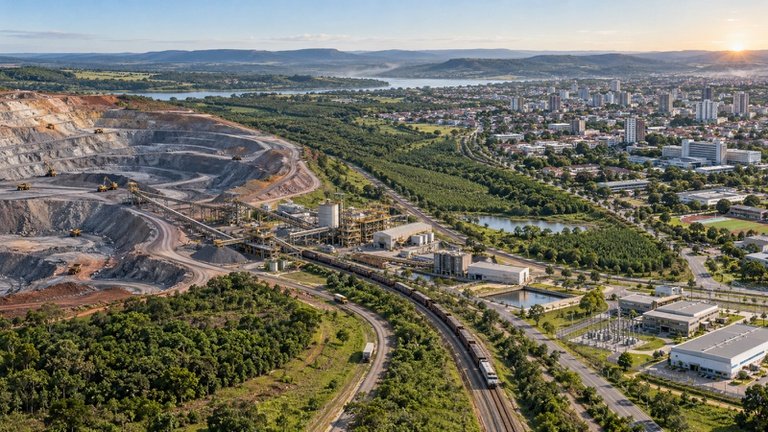
Brazil enacted a national policy for critical and strategic minerals on September 16, 2026, establishing a new federal framework intended to support mineral research, mining, processing, transformation and urban mining.
Law No. 15,506 created the National Policy for Critical and Strategic Minerals, known by its Portuguese acronym PNMCE, and the National Council for Industrialization of Critical and Strategic Minerals, or CIMCE. Decree No. 13,118, issued on the same date, sets out the council’s structure and functions. The policy was publicly announced on September 17.
What happened
The legislation links the new policy to a broad set of state objectives: expanding domestic capacity in research, processing and transformation; supporting the energy transition and technology; and contributing to food security, regional development, defense and national sovereignty.
Rather than setting a permanent list of priority commodities in the law itself, the framework gives the CIMCE responsibility for defining and updating the list of critical and strategic mineral substances. The process must follow a substantiated proposal from the Ministry of Mines and Energy.
The CIMCE is linked to the Presidency of the Republic. Its plenary is chaired by the minister of the Casa Civil, while its executive committee is coordinated by the Ministry of Development, Industry, Trade and Services, known as MDIC.
Under the decree, the council will approve a national plan, prioritize and enable projects, and manage the process for identifying the mineral substances covered by the policy.
Why it matters
The new framework extends beyond extraction. It explicitly covers research, mining, processing, mineral transformation and urban mining, the recovery of materials from products and waste streams. That scope places emphasis on developing domestic industrial capacity alongside access to mineral resources.
It also creates mechanisms intended to direct support towards selected projects. A public national project registry will be linked to SIGMINE, the federal mineral-information system. The law provides for a traceability system for minerals and related products, but the technical standards and deadlines for adaptation have yet to be defined through further regulation.
The legislation does not transfer the mining regulator’s core functions. The National Mining Agency, or ANM, retains its regulatory, inspection and mineral-rights granting powers.
By the numbers
- Up to R$2 billion: The law authorizes federal participation of up to this amount in a Mineral Activity Guarantee Fund, subject to budget availability and an act by the Finance Ministry.
- Up to 20%: The Mineral Activity Financing Program, or PFMCE, may offer fiscal credits of up to 20% of eligible expenditure.
- R$1 billion a year: Aggregate annual fiscal credits are capped at this level in each year from 2030 through 2034, subject to regulation, budget provisions and a competitive selection process.
- 0.3% and 0.2%: Once regulations are in force, covered companies will face obligations equal to 0.3% of qualifying gross operating revenue for research, development and innovation, and 0.2% for contributions to the guarantee fund, for six years.
- At least 0.5%: After that six-year period, the innovation obligation will be at least 0.5% of qualifying gross operating revenue.
The bigger picture
The policy combines industrial planning with financial incentives and compliance requirements. Its stated design is to promote greater value addition within Brazil while introducing project-prioritization, traceability and funding instruments for the minerals that the council ultimately identifies as critical or strategic.
However, the law and decree establish the framework rather than a complete operating system. They do not name a fixed list of priority minerals, and several rules essential to implementation remain outstanding. These include regulations governing project eligibility, the procedure for fiscal credits, traceability standards and certification.
What happens next
The CIMCE will need to develop the national plan and consider proposals from the Ministry of Mines and Energy on which mineral substances should be included on the critical and strategic list. Federal authorities must also issue the regulations that will determine how projects qualify for support, how fiscal-credit mechanisms operate, and how traceability and certification requirements are applied.
Until those measures are issued, the law provides Brazil with an institutional and financial-policy framework, but not yet a final operational map of which minerals and projects will receive priority treatment.