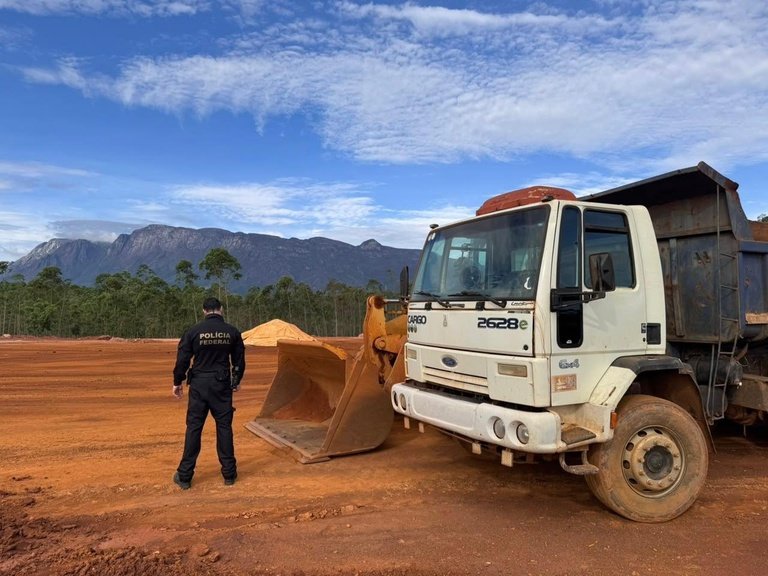
Brazil’s Federal Police launched Operation Húbris on November 25, 2026, targeting an alleged network involved in the unauthorized extraction, transport, processing and sale of iron ore in Minas Gerais, one of the country’s principal mining states.
The operation, carried out with the federal comptroller general’s office, known as the CGU, and with support from federal prosecutors and the Federal Revenue Service, is at the investigation stage. Authorities allege offenses including the unlawful appropriation of Union-owned mineral resources, unauthorized extraction, criminal organization and money laundering, as well as possible offenses involving public officials. No charging decision, trial, conviction or final finding of guilt has been identified.
The Federal Police said 230 officers and 20 CGU personnel took part in the action. The measures were authorized by the 1st and 2nd Federal Criminal Courts in Belo Horizonte.
A supply-chain investigation, not only an extraction case
The case is structured around an alleged commercial chain rather than a single mining site. According to investigators, the network included extraction operators, transporters, intermediaries, processing operations, commercial intermediaries and financial operators.
That alleged structure is significant because it describes how ore extracted outside authorization could potentially enter broader commercial channels. Investigators say the suspected scheme relied on activities that can have legitimate purposes—such as earthmoving, slope stabilization, recovery of degraded areas, construction work and interventions on private land—to make clandestine extraction appear lawful.
The allegations have not been tested at trial. The authorities’ account is therefore an investigative theory, and the measures announced on November 25 are designed to preserve the inquiry and restrict the economic capacity of the people and entities under investigation rather than determine criminal responsibility.
Arrest and search orders
Authorities executed eight preventive-arrest warrants, two temporary-arrest warrants and search orders at more than 50 residential and business addresses. Official releases establish the execution of the warrants, but do not establish that all 10 people targeted by arrest warrants were physically detained. Subsequent reporting cited eight arrests.
Preventive and temporary detention are precautionary measures ordered during an investigation; they are not convictions. Similarly, the searches form part of evidence-gathering efforts and do not establish that the targets committed the alleged offenses.
The operation’s formal name, Húbris, is used by the authorities for the investigation. The package of measures covers individuals and companies, reflecting the alleged role of commercial and financial links alongside the extraction activity itself.
R$2 billion asset measures and the estimated ore volume
The federal courts authorized seizure and blocking measures against 45 individuals and legal entities, capped at R$2 billion. The orders can cover real estate, vehicles, financial resources, investments and cryptoassets.
For investigators, the immediate mechanism is to limit access to assets while the case proceeds and to preserve resources that could be relevant to a possible future restitution process. The orders are precautionary: they are not a final confiscation judgment and do not amount to a judicial conclusion that the assets were obtained unlawfully.
Police forensic work estimated that about 5.74 million tonnes of ore may have been processed under irregular conditions, with an estimated economic value of R$2 billion. Both figures are investigative and forensic estimates, rather than final judicial findings. The similarity between the estimated value and the cap on the asset measures does not turn either figure into a final assessment of loss or liability.
Why it matters
Iron ore is a major mineral commodity, and the inquiry focuses on the integrity of the chain that moves material from extraction through transportation, processing, sale and the handling of proceeds. The alleged use of apparently lawful land or construction-related activities to conceal extraction is central to the authorities’ account of how unlicensed ore could be presented as regular material.
The case also illustrates the role of precautionary financial measures in a complex economic investigation. Rather than waiting for a final ruling, courts can authorize restrictions intended to prevent investigated parties from moving assets and to preserve potential resources for restitution if the allegations are later substantiated through the legal process.
Those directly affected include the 45 individuals and legal entities subject to seizure or blocking measures, as well as the people and businesses whose addresses were searched or who were targeted by arrest warrants. The broader institutional consequence is a coordinated federal inquiry involving police, auditors, prosecutors and tax authorities into alleged mineral-resource offenses and associated financial activity.
What happens next
The investigation will continue after the execution of the arrest, search and asset measures. Investigators will assess evidence related to the alleged extraction and commercial chain, including the movement, processing and sale of ore and the financial operations under scrutiny.
Any decision to bring charges, and any eventual assessment of criminal or civil responsibility, would require further procedural steps. No material response from investigated parties was included in the consulted material, and the available information does not identify individual suspects. Until a court reaches a final determination, the authorities’ allegations remain allegations.