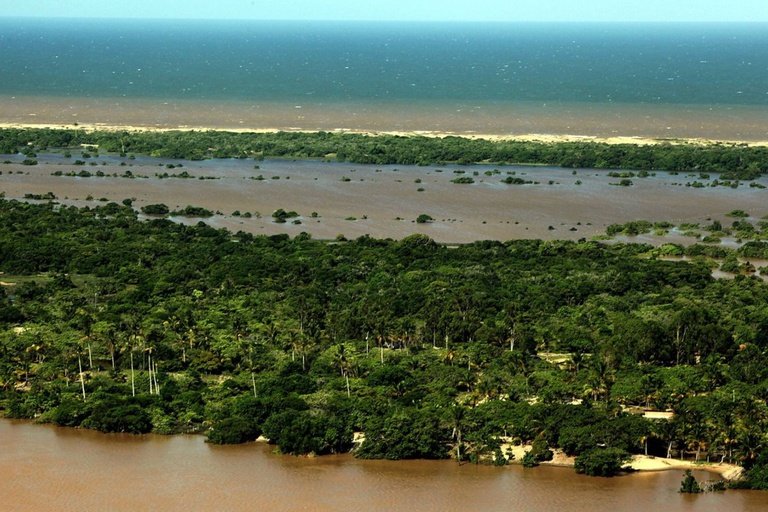
On November 5, 2015, the Fundão tailings dam at Samarco’s Mariana operation collapsed in Minas Gerais, killing 19 people. Mining waste moved through the Rio Doce basin, across Minas Gerais and Espírito Santo, and reached the Atlantic coast. The volume has commonly been described as about 40 million cubic metres, although official accounts differ over that estimate and over the full geographic and population scope of the impacts.
The disaster remains a defining test of how Brazil handles long-running environmental damage from mining. Its significance is not only the scale of the release or the human loss: it is also the shift now under way in the machinery of reparation. A 2024 judicial agreement replaced the principal framework created after the collapse, moving much of the implementation role away from Fundação Renova and toward public authorities financed by the companies, alongside obligations that the companies will continue to execute themselves.
The new framework has started to move money and approve projects, but those steps are not evidence that full repair has been achieved. Long-term ecological restoration remains incomplete, while criminal and civil accountability proceedings continue on separate tracks in Brazil and England.
A disaster whose consequences outlast the emergency
Samarco was the operator of the Fundão dam. The collapse created a river-basin disaster rather than a damage event confined to the mine site: the waste travelled down the Rio Doce system to the coast. That geography helps explain why repair has involved more than rebuilding or cleaning a single location. It has required a structure able to address impacts spread across multiple territories and over a long period.
Brazil’s first major response framework was established in 2016 through the TTAC agreement. Its implementation was largely placed under Fundação Renova. That model was subsequently criticized for slow and inadequate delivery. The criticism matters because the replacement agreement does not simply add funding to the previous structure; it changes who is expected to carry out, finance and oversee the work.
For affected communities and public institutions, the institutional question is central. Compensation and remediation can be delayed or fragmented when responsibility is concentrated in an intermediary entity that does not itself hold the full range of public-policy powers. The 2024 arrangement seeks to address that problem by separating public programs from company-executed duties and by formally ending Renova’s role.
How the R$170 billion agreement is structured
On October 25, 2024, governments and justice institutions signed a replacement agreement with Samarco, Vale and BHP. Brazil’s Supreme Federal Court, the STF, homologated the agreement on November 6, 2024, giving the arrangement judicial approval.
The agreement is stated at R$170 billion. Its components show the intended division between future public action, continuing corporate duties and spending already reported:
- R$100 billion in new transfers to public authorities over 20 years;
- R$32 billion in company-run compensation and remediation obligations; and
- about R$38 billion recognized as previously spent.
The distinction is consequential. The R$100 billion is not a one-time payment: it is a two-decade transfer stream intended to finance programs run by public authorities. The R$32 billion, meanwhile, refers to obligations to be carried out by the companies. The approximately R$38 billion is recognition of earlier expenditure, rather than a new pool of funds for future measures.
The agreement also orders Fundação Renova’s closure. In practical terms, that redistributes implementation and oversight responsibilities. Public authorities are to run programs supported by company transfers, while companies remain responsible for designated compensation and remediation work. The model therefore makes government institutions more directly responsible for the delivery of a substantial part of the response, while retaining corporate obligations within the settlement architecture.
Early execution is measurable, but not final repair
There is now evidence that the replacement framework is being put into operation. By September 2026, the federal government reported 55 approved projects and approximately R$3.7 billion transferred under the new agreement.
Those figures provide a concrete baseline for tracking execution. Project approvals indicate that programs have passed an initial administrative stage, while transfers indicate that funds have begun to move into the public-authority side of the arrangement. They do not, however, establish that the underlying harm has been fully compensated or that environmental restoration has been completed.
That distinction is especially important in a river-basin case. A signed settlement, a project list and transferred funds are all milestones in implementation; they are not equivalent to a finding that ecosystems have recovered or that all affected people have obtained effective reparation. The agreement’s 20-year schedule also makes clear that the intended response is long-term.
Accountability remains divided across legal proceedings
The reparation agreement does not settle every accountability question arising from the collapse. In September 2026, Brazil’s Federal Regional Court of the 6th Region, or TRF6, partially reversed trial-level acquittals and convicted Samarco and three former managers. At the same time, the court maintained acquittals for Vale, BHP Billiton Brasil, VOGBR and other defendants.
These are not final judgments. Further appeals may be available, so the convictions should not be treated as conclusive outcomes of the criminal process. The mixed result also underscores that the court did not impose the same outcome on all corporate and individual defendants.
Separate mass civil litigation is proceeding in England against BHP. At the first liability stage, the English High Court found BHP liable, while questions of damages are being addressed separately. BHP has argued that the English case duplicates compensation and legal mechanisms already available in Brazil. The High Court’s liability finding means that argument did not prevent the case from advancing at that stage, but it does not itself determine individual compensation awards.
What happens next
The next test is execution over time. Under the Brazilian agreement, public authorities must turn the funding stream into operating programs, while the companies must meet their separate compensation and remediation obligations. The reported 55 approved projects and R$3.7 billion in transfers provide an early marker against which future delivery can be assessed.
At the same time, the legal picture remains open. The Brazilian criminal convictions are still subject to the appellate process, and the English litigation has moved beyond its first liability stage without yet resolving damages. For the Rio Doce basin, the central unresolved measure remains whether the new institutional model can deliver durable restoration and effective reparation—not merely agreements, transfers and administrative milestones.