On January 25, 2019, Vale’s upstream B1 tailings dam at the Córrego do Feijão mine collapsed in Brumadinho, Minas Gerais. The disaster became a defining test of corporate accountability, mine-waste oversight and environmental repair in Brazil.
Seven years later, its consequences are being addressed through distinct legal and policy tracks that should not be conflated. A court-approved collective-repair agreement finances compensation and programs across the affected Paraopeba basin. Individual claimants can still pursue their own claims. Separately, federal criminal proceedings are gathering evidence, and no criminal conviction has been established.
The Minas Gerais repair portal records 272 victims, including two unborn children. Criminal proceedings, however, concern 270 alleged homicide victims. The difference reflects the separate official frameworks used for public repair and criminal charges; it does not mean there are 272 homicide counts.
From emergency measures to a collective-repair agreement
On the day of the collapse, a Minas Gerais court ordered an initial R$1 billion block on Vale assets and imposed emergency duties involving rescue, containment, monitoring and cleanup. On July 9, 2019, a court decision recognized Vale’s civil obligation to repair all damage caused by the collapse, while the identification and quantification of that damage continued.
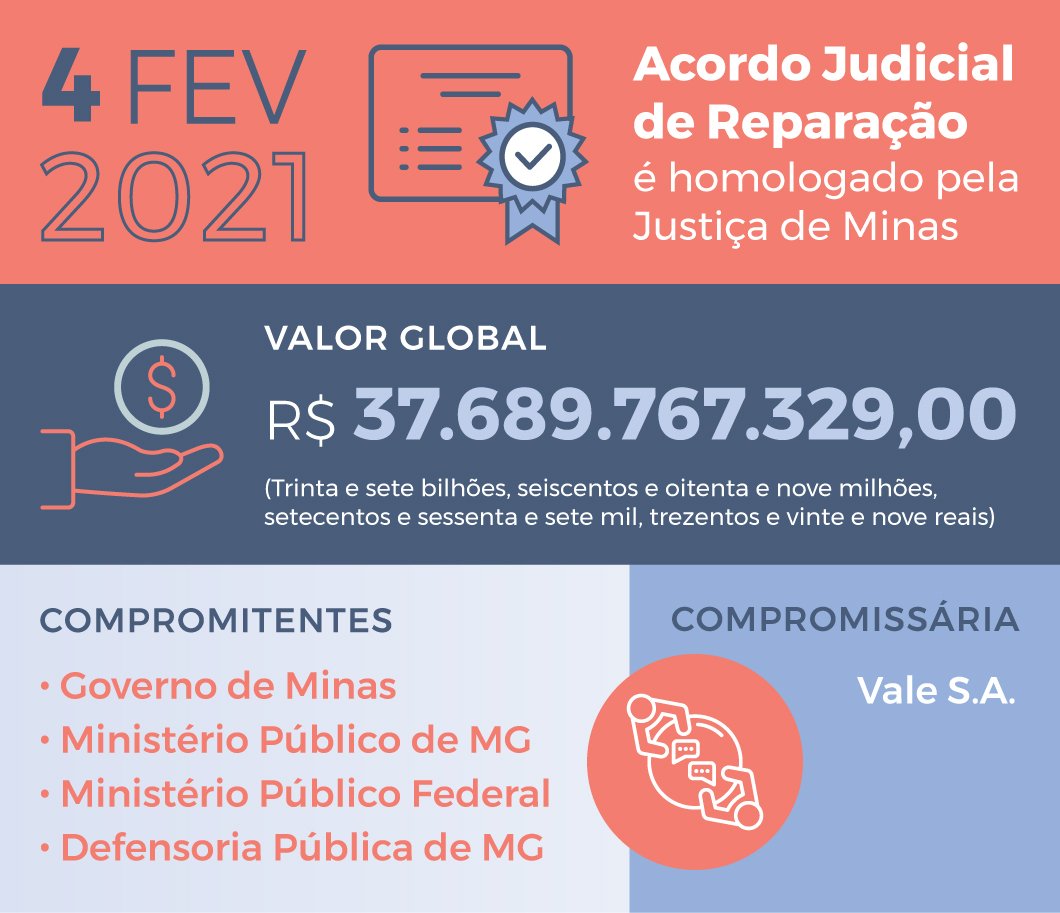
That civil process culminated on February 4, 2021, when Vale, the state of Minas Gerais, state and federal prosecutors, and the state public defender entered a court-approved agreement valued at R$37.689 billion. It covers collective and diffuse socioeconomic and socioenvironmental damage, rather than functioning solely as a payment fund for bereaved families.
The agreement applies to Brumadinho and 25 other municipalities considered affected. Its programs include community projects, income transfers, measures for the Paraopeba basin, environmental recovery, water security and mobility. This structure reflects the breadth of damage from a tailings-dam failure: the required response extends beyond the mine site and beyond one-time compensation to people whose livelihoods, local infrastructure and river-basin conditions were affected.
The settlement did not end potential individual claims and did not resolve criminal liability. Vale’s participation in civil reparation is not a criminal admission.
Payments show activity, not completed repair
According to the Minas Gerais portal’s 2026 update, 7,806 people had received roughly R$1.3 billion through an individual compensation mechanism. Separately, 2,509 workers had received more than R$1.2 billion.
Those figures document substantial payments through two channels: one directed to individual claimants and another to workers. But they are not a measure that environmental and socioeconomic repair has been completed. The state portal continues to list programs covering basin measures, recovery and other collective actions, indicating that the broader repair process remains under way.
For communities in the affected municipalities, the mechanism matters because collective damage is handled through projects and public-interest programs while personal losses and worker claims have separate compensation routes. The 2021 agreement’s design also means its headline value cannot be read simply as money already paid directly to individuals.
Criminal cases are now in the evidence stage
In January 2020, Minas Gerais prosecutors charged 16 individuals with qualified homicide and environmental crimes, and charged Vale and TÜV SÜD with environmental crimes. These were accusations, not findings of guilt. Subsequent procedural decisions altered the number of people actively involved at particular stages, so the original figure should not be treated as a fixed count for the current federal proceedings.
The federal criminal cases are now in the evidentiary trial phase. Hearings began on February 23, 2026 and are scheduled to continue into 2027, with witness and other evidence being produced. Their institutional purpose is to test the allegations through the judicial process; criminal responsibility depends on final judgments, not on the filing of charges.
Vale has joined the civil settlement while pursuing defenses and procedural challenges in the criminal cases. The company’s civil participation therefore does not settle the question before the criminal courts.
Regulatory findings and the shift away from upstream dams
The disaster also drove changes in Brazilian mining regulation. The National Mining Agency, known as ANM, reported that Vale had detected piezometer emergencies and abnormal radar readings that were not promptly disclosed to the regulator. The agency issued 24 notices of violation and referred its findings to other authorities.
Those administrative findings are important to understanding the governance consequences of Brumadinho, but they are not themselves a criminal judgment. They informed a broader scrutiny of how operators report safety anomalies and how regulators monitor high-risk structures.
Brazil subsequently enacted Law 14,066/2020, tightening the National Dam Safety Policy. The law prohibited the construction or raising of upstream dams and required the decommissioning of existing structures subject to its statutory framework. B1 was an upstream dam, placing the disaster at the center of a regulatory shift away from that design.
The impact also reached beyond Brazil. The UN Environment Programme, the Principles for Responsible Investment and the International Council on Mining and Metals convened the Global Tailings Review after Brumadinho. That process produced the 2020 Global Industry Standard on Tailings Management, linking the Brazilian disaster to an international effort to strengthen tailings safety practices.
What happens next
The immediate next legal milestone is the continuation of federal evidentiary hearings into 2027. The proceedings will determine whether the allegations can be sustained under the applicable criminal standard; at present, no criminal conviction has been identified.
Outside the courtroom, implementation of the collective-repair agreement continues across the 26 municipalities covered by the framework. The core legacy of Brumadinho is therefore twofold: a long-term, multi-channel effort to address human, environmental and economic harm in Minas Gerais, and a lasting change in the rules governing a mine-waste technology that Brazil has moved to phase out.