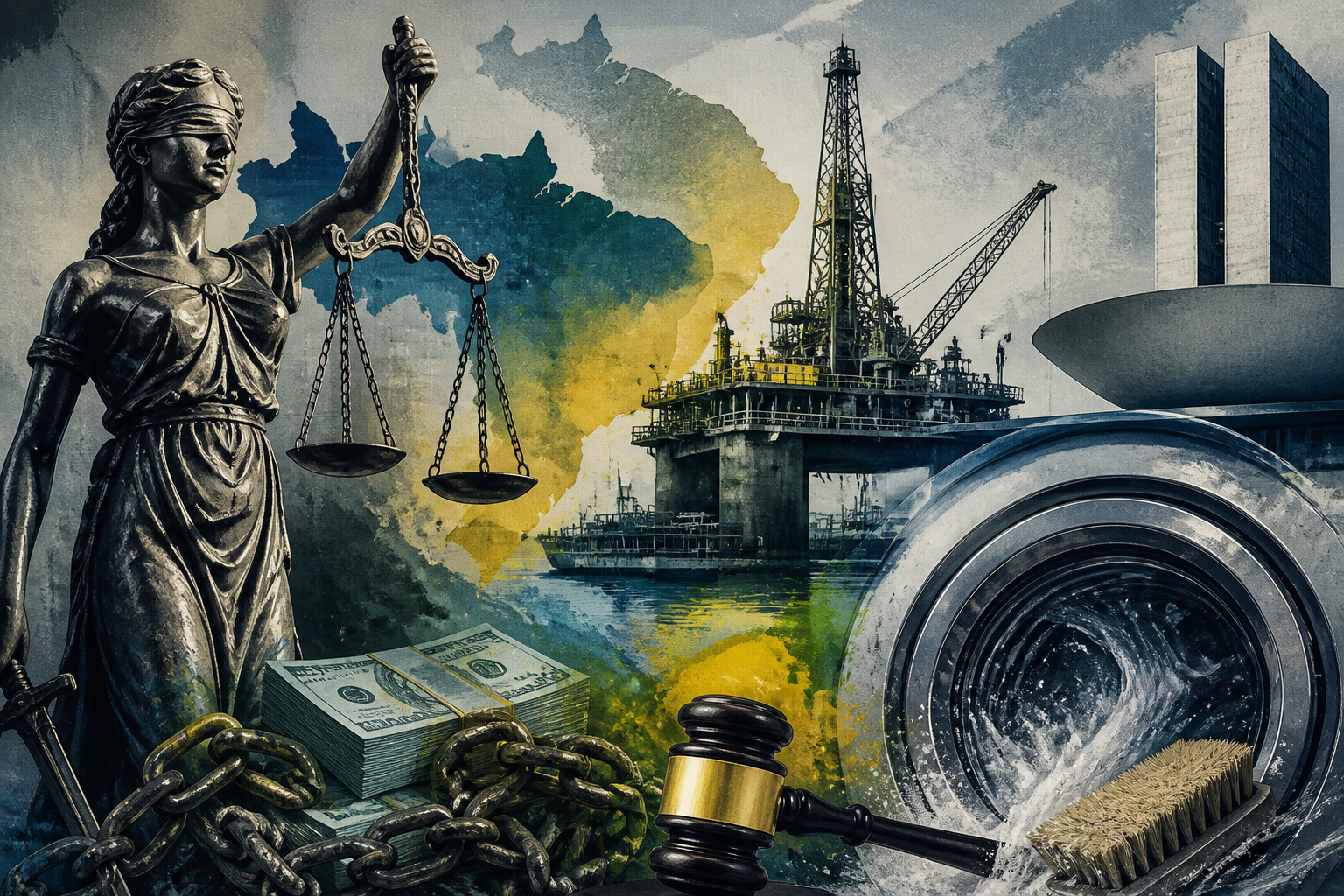
Brazil’s Operation Car Wash, known locally as Lava Jato, began on March 17, 2014 as a Federal Police investigation combining four inquiries into illegal currency dealing, financial crimes and the diversion of public resources. It soon expanded into Petrobras, the state-controlled oil company, and became a broad legal and political reckoning over public contracting, illicit payments and political finance.
For readers outside Brazil, one distinction is essential to understanding its legacy: the investigation produced arrests, cooperation agreements, charges and convictions involving different defendants, but those outcomes were legally separate. The later Supreme Federal Court, or STF, rulings concerning former president Luiz Inácio Lula da Silva did not invalidate the entire operation or determine whether the allegations in his cases were true. They addressed which court could hear four proceedings and, separately, whether the judge in one case was impartial.
How the Petrobras contracting scheme worked
Petrobras reported that contractors colluded to obtain contracts and overprice them between 2004 and April 2012. Part of the resulting overpayments was used for improper payments to political parties, elected or public officials and other participants.
The mechanism mattered because it connected a company’s procurement process to political finance. Rather than treating bribery as an isolated exchange, the evidence described a system in which inflated contract values created room for kickbacks and other improper payments. The U.S. Securities and Exchange Commission found that former Petrobras executives exploited deficiencies in the company’s internal controls, and that kickbacks commonly represented 1% to 3% of contract values. The SEC’s findings concerned Petrobras securities-law and accounting-control violations.
This combination of collusion, overpricing and control failures explains why the case reached beyond individual contracts. Petrobras is a major listed company as well as a state-controlled enterprise, making the integrity of its contracting and financial controls relevant to public administration, corporate governance and investors. The investigation’s allegations and evidence also touched contractors, Petrobras personnel, financial intermediaries, politicians and political parties.
From a financial-crimes inquiry to a national investigation
The Federal Police initially brought together four investigations. As investigators followed financial transactions, the inquiry broadened from money laundering and illegal currency dealing to Petrobras contracting. That expansion is central to Lava Jato’s historical significance: it placed the operations of a major state-controlled company alongside questions about public funds and political payments.
Yet the scale of an investigation does not make every proceeding interchangeable. A case can involve serious allegations and still be subject to constitutional rules on jurisdiction, judicial impartiality and due process. The later litigation involving Lula became a prominent example of that institutional limit.
Lula denied wrongdoing, and his lawyers described his convictions as unjust. The judicial rulings discussed below did not decide guilt or innocence in the underlying allegations.
Why Lula’s convictions were annulled
On March 8, 2021, STF Justice Edson Fachin annulled decisions issued by the 13th Federal Court in Curitiba in four proceedings against Lula: the Guarujá triplex, the Atibaia property, the Lula Institute headquarters and donations to the institute. The basis was jurisdiction: Fachin concluded that the Curitiba court was not the competent venue for those cases.
The STF’s full court upheld that jurisdiction finding by an 8-3 vote on April 15, 2021. A week later, on April 22, the court determined that the proceedings should be heard by the Federal Court in the Federal District. The April 22 decision selected the proper venue; it was not a separate ruling independently annulling the convictions.
The legal mechanism is consequential. When a court is found not to have jurisdiction, procedural decisions it issued in the affected cases are invalidated. That is what occurred with the decisions and convictions in the four Lula proceedings. It was not an acquittal, nor a judicial finding that the underlying allegations were false.
The jurisdiction rulings also restored Lula’s political eligibility. This showed how procedural law can have immediate institutional consequences: a ruling about the authority of a court can alter a former president’s ability to participate in electoral politics without resolving the factual merits of accusations.
A separate ruling on Judge Sergio Moro
A second STF decision concerned a different due-process question in one of the cases, the Guarujá triplex proceeding. On March 23, 2021, the STF’s Second Panel found former judge Sergio Moro to have been biased in that case. The full STF upheld that conclusion by a 7-4 vote on June 23, 2021.
This bias ruling should not be merged with the jurisdiction decisions. Jurisdiction asks whether a particular court had legal authority to hear a case. Judicial bias concerns whether the judge met the requirement of impartiality. Both can affect the validity of a proceeding, but they are distinct legal grounds, issued on different dates and through different STF decisions.
For the triplex case, the final STF confirmation of Moro’s disqualification added an independent due-process basis to the legal history. It did not amount to a general finding about every Lava Jato case, every defendant or all judicial acts connected to the operation.
Political and market consequences
The March 8, 2021 decision had an immediate political consequence by restoring Lula’s eligibility. It also prompted a documented market reaction: Reuters reported that the real fell by about 1.5% and the Bovespa declined 3% after Fachin’s decision.
That reaction illustrates a transmission channel rather than a judgment on the merits of the legal cases. A major court decision changed the country’s political landscape by allowing a former president to return to electoral eligibility. Markets responded to the resulting political uncertainty, which can affect expectations around government direction and corporate conditions. The available record establishes the immediate moves, not a forecast for Brazilian assets or a definitive explanation for all trading.
Why the legal distinctions still matter
Lava Jato’s record includes documented concerns over Petrobras contracting and internal controls, as well as a large body of individual investigations and cases. But its legacy also depends on the rules used to pursue accountability. The STF decisions underscore that allegations, charges and even convictions remain subject to review for jurisdiction and due process.
For Lula, the final procedural outcome was clear: the Curitiba court’s decisions in the four proceedings were annulled for lack of jurisdiction, the cases were assigned to the Federal Court in the Federal District, and the STF separately upheld Moro’s disqualification for bias in the triplex case. Those rulings did not establish innocence or falsity of the allegations. They established that legal accountability must be pursued by a competent court and through proceedings that satisfy impartiality requirements.