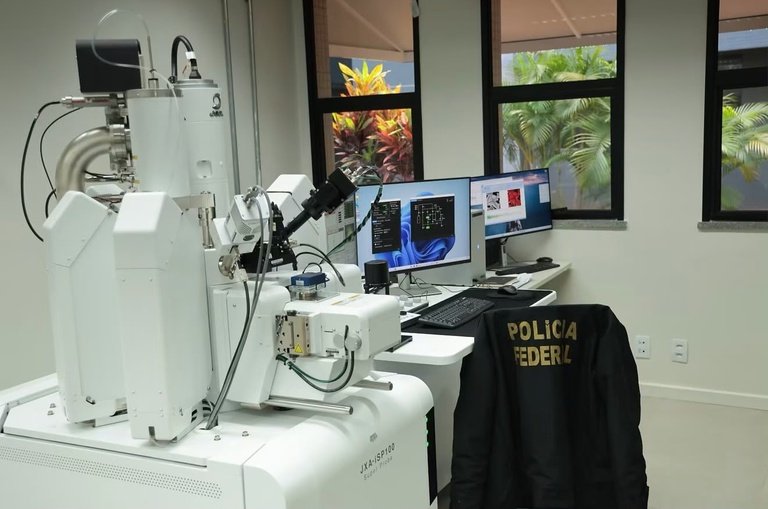
Brazil’s Federal Police inaugurated a forensic laboratory in Brasília on November 3, 2026, intended to help investigators assess the possible origin of seized gold. The new Laboratório de Geoquímica Forense para Rastreabilidade Mineral is based at the Federal Police’s National Institute of Criminalistics and is designed to support investigations into illegal mining and related environmental crimes.
The facility’s significance lies in the type of evidence it seeks to produce. Rather than relying only on documentation accompanying gold through the supply chain, investigators aim to compare a seized sample’s geochemical and isotopic characteristics with reference profiles compiled from Brazilian mineral deposits. A match or similarity could help establish a possible provenance for the metal under investigation.
The inauguration is a delivery of investigative capacity. There are not yet independently verified figures showing how the laboratory has affected casework, prosecutions, seizures or environmental-crime reductions.
How the gold-tracing method is meant to work
Gold from different deposits can carry geochemical and isotopic characteristics that can be used as reference markers. The laboratory’s stated approach is to build a body of reference data for Brazilian deposits and compare that information with samples of gold seized during investigations.
In practical terms, this is intended to give police a scientific basis for examining whether seized gold may be consistent with a particular source. That can be relevant when investigators are assessing suspected illegal mining and environmental crimes linked to mineral extraction.
The method does not, on the facts currently available, amount to a published finding about any specific seizure, mining area, company or individual. Its documented purpose is to strengthen the evidentiary capacity available to investigations by adding mineral-origin analysis.
A forensic addition to a wider Amazon security plan
The laboratory is part of Programa Ouro Alvo, a Federal Police programme within Plano Amazônia: Segurança e Soberania, known as AMAS. The plan brings together the Federal Police, Federal Highway Police, National Public Security Force and the governments of the nine states in Brazil’s Legal Amazon.
That structure places the laboratory within a broader effort spanning intelligence, investigation and inspection or enforcement capacity. The laboratory itself is located in Brasília, while the programme is connected to challenges affecting the Legal Amazon, the official regional grouping of nine Brazilian states.
For readers outside Brazil, the institutional point is that mineral traceability is being positioned as one element of a multi-agency security and enforcement architecture. The laboratory is not presented as a standalone system for regulating gold; it is intended to provide forensic support when gold is seized and a possible source needs to be assessed.
Funding: what the announced figures do and do not cover
The AMAS plan has R$318.5 million from the Amazon Fund for intelligence, investigation and inspection or enforcement capacity. That amount should not be read as the cost of the laboratory alone.
According to the Federal Police, R$49.7 million of the wider funding was directed to the technological-park and gold-traceability laboratory agenda. The package does not provide a separate cost for the laboratory itself, nor does it specify a division of that allocation among individual technologies or activities.
The distinction matters for public oversight. The R$318.5 million figure describes financing for the wider AMAS plan, while the R$49.7 million figure refers to the broader technological and traceability agenda that includes the laboratory.
Why it matters
Gold is a compact, high-value mineral, and determining where a seized sample may have come from can be important to investigations seeking to connect material evidence with suspected illegal extraction or associated environmental offences. The new facility is intended to improve that connection through scientific comparison, potentially supplementing other investigative work.
Its relevance therefore rests on an evidentiary mechanism: reference profiles from deposits are compared with seized gold, producing information that may help investigators assess provenance. This is different from a claim that the laboratory has already deterred illegal mining or generated enforcement outcomes.
Whether the capability changes investigations in practice will depend on results that have not yet been independently measured, including its accuracy in casework, its use in investigations and any effect on deterrence. No verified data currently attribute prosecutions, seizures or reductions in environmental crimes to the facility.
What happens next
The documented next phase is the use of the laboratory’s geochemical and isotopic reference data to examine seized-gold samples in support of Federal Police investigations. The relevant benchmark will be operational evidence of how the capability is used in casework, rather than the inauguration alone.
For now, the confirmed development is the opening of a federally operated forensic facility and the allocation of Amazon Fund-backed resources to the wider technological and gold-traceability agenda. Its eventual enforcement effect remains to be established independently.