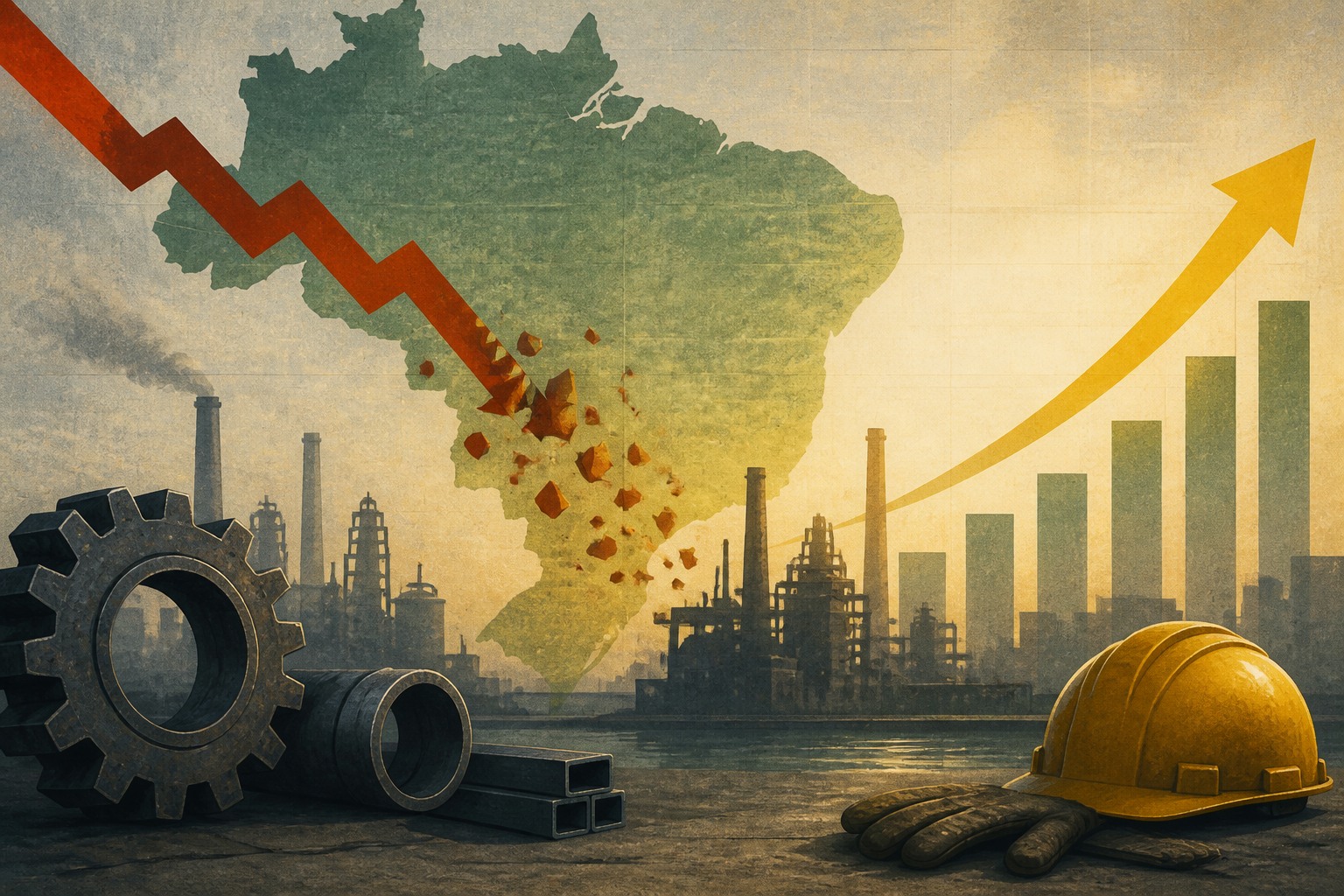
Brazil’s industrial sector lost businesses and jobs at a substantial rate between 2013 and 2019, establishing a structural benchmark that still shapes assessments of the country’s economic recovery. The national statistics agency IBGE recorded a decline in the number of industrial enterprises from 334,976 in 2013 to 306,345 in 2019, a fall of 8.5%.
Over the same period, industrial employment measured by IBGE’s Annual Survey of Industry, or PIA-Empresa, fell from 9,029,154 people to 7,617,795. That was a reduction of 15.6%, or about 1.41 million jobs.
The period, running from January 2013 through December 2019, matters because it provides a pre-pandemic reference point for a sector central to Brazil’s production base. More recent data show that industrial employment has expanded again, but had not fully regained its earlier level in the latest comparable structural release.
What happened
PIA-Empresa measures formally constituted industrial enterprises and their employment. Its figures show that employment fell faster than the number of enterprises during the 2013–2019 contraction.
Manufacturing dominated industrial employment at the end of the period, accounting for 97.5% of industrial jobs in 2019. IBGE said manufacturing employment declined by 786,163 people between 2010 and 2019.
The data establish the scale of the contraction but do not, on their own, identify a single cause. International Monetary Fund assessments published during the downturn documented weak investment, cuts to Petrobras capital expenditure and structural competitiveness constraints. Those assessments provide context for the period, but they do not demonstrate that any one factor caused the full decline reported in the PIA-Empresa series.
Why it matters
Brazil’s industrial employment has shown a later recovery. IBGE’s 2023 PIA-Empresa results put the sector’s workforce at 8.5 million people, following four consecutive annual increases. Yet that level remained 3.1% below the 2014 level.
This supports a measured conclusion: industrial employment has recovered from its 2019 low, while the latest structural data do not show a full restoration to the earlier benchmark. The 2013–2019 decline therefore remains relevant when evaluating the depth and durability of the recovery.
It also cautions against treating stronger headline labor-market figures as proof that industrial losses have been completely reversed. Employment totals depend on what a survey measures, and different IBGE series answer different questions.
The bigger picture
IBGE’s PNAD Contínua household survey reported 103.0 million people employed across Brazil’s economy in 2025. The annual unemployment rate was 5.6%, the lowest annual rate in the survey’s series beginning in 2012.
Those figures point to a broad improvement in the national labor market. But they cannot be directly compared with PIA-Empresa as a measure of industrial recovery. PNAD covers employment across sectors of the economy, whereas PIA-Empresa covers formally constituted industrial enterprises.
As a result, the 2025 economy-wide employment record neither proves nor disproves that industrial employment has fully recovered. The later PIA-Empresa data provide the more relevant evidence for that narrower question: four years of gains through 2023, with employment still below its 2014 level.
By the numbers
- 334,976: industrial enterprises recorded by PIA-Empresa in 2013.
- 306,345: industrial enterprises recorded in 2019, down 8.5% from 2013.
- 9.03 million: industrial workers recorded in 2013.
- 7.62 million: industrial workers recorded in 2019, down 15.6%, or about 1.41 million people.
- 8.5 million: industrial workers recorded in 2023 after four consecutive annual increases, though still 3.1% below the 2014 level.
- 103.0 million: people employed across Brazil’s economy in 2025, according to PNAD Contínua.
What happens next
Future PIA-Empresa releases will show whether the industrial employment recovery continues and whether the sector returns to, or exceeds, its earlier employment level. The available figures do not by themselves establish a productivity trend, so productivity remains a separate analytical question requiring measures beyond enterprise and employment counts.