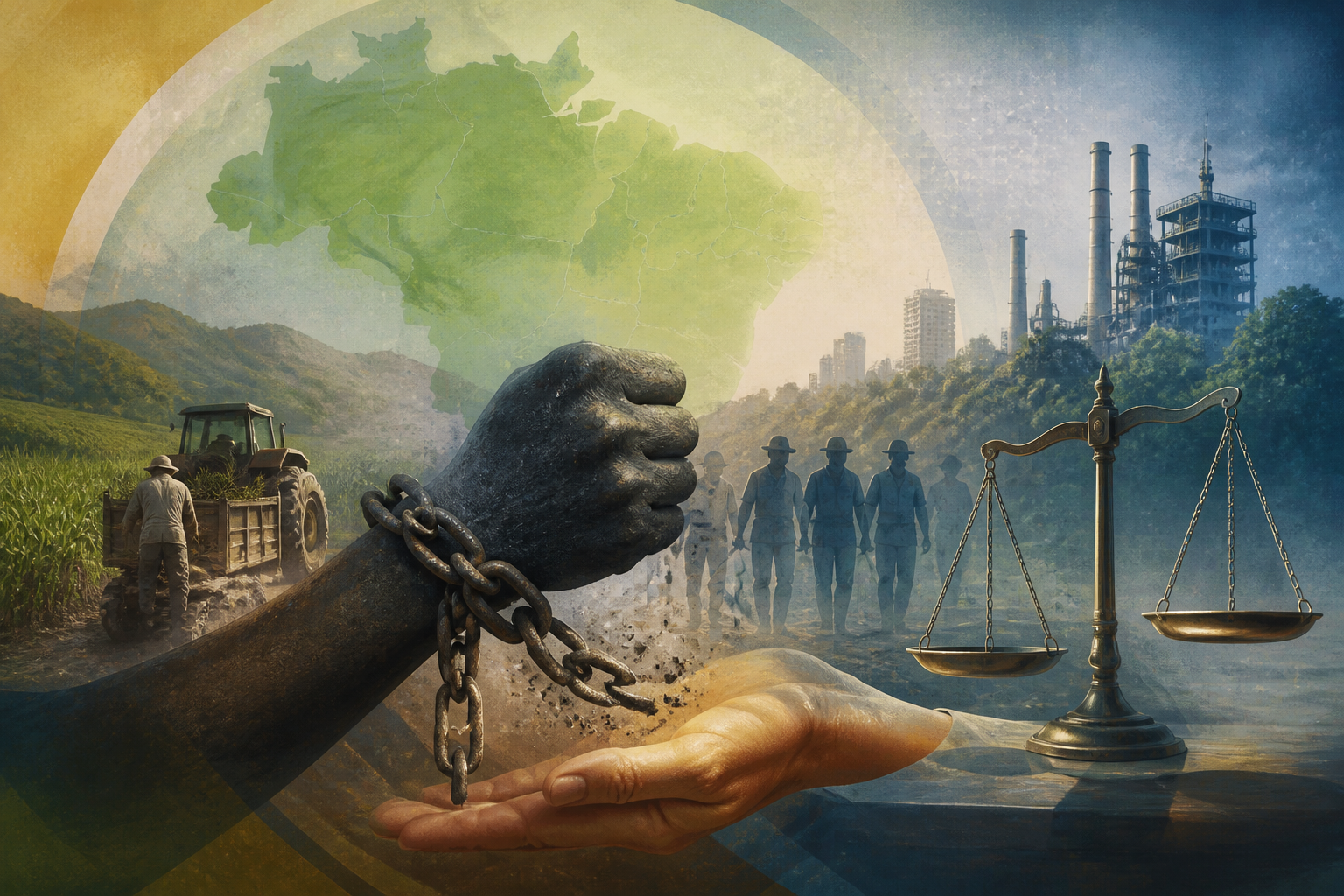
On June 27, 1995, Brazil’s government publicly recognized that contemporary slave labor continued to exist in the country. The acknowledgement, made during the presidency of Fernando Henrique Cardoso, became a landmark in the development of a coordinated state response to severe labor-rights violations.
That response had already begun to take institutional form earlier that month. The International Labour Organization’s Normlex record notes that Brazil created its Special Mobile Inspection Group on June 14, 1995. Over the following three decades, the country built an enforcement and worker-protection structure involving labor inspections, mobile operations, interagency coordination, assistance for workers removed from abusive conditions and an unemployment-insurance mechanism for rescued workers.
The system’s recent figures illustrate both its continued use and an important limit on what the data show: inspection outcomes and administrative measures can establish labor-enforcement findings, worker removals and payments, but they do not by themselves establish criminal guilt or criminal convictions of employers.
What happened in 1995
Brazil’s 1995 recognition was significant because it brought contemporary slave labor into the scope of explicit public policy. The Special Mobile Inspection Group became a central operational tool, conducting inspections intended to identify workers in conditions analogous to slavery and secure their removal.
The enforcement framework now encompasses more than inspections. It includes assistance to workers, coordination among public bodies and mechanisms intended to ensure that workers receive labor and termination payments after removal. The Ministry of Labor and Employment, known by its Portuguese initials MTE, also maintains administrative employer-accountability tools.
One such tool is an employer register. Inclusion requires due administrative process, meaning that an employer’s placement on the register follows an administrative procedure rather than an automatic consequence of an inspection. These administrative processes are distinct from criminal proceedings.
Why it still matters
Thirty years after the 1995 acknowledgement, official data show that labor inspectors continue to identify workers and obtain payments connected to enforcement operations. Agriculture and construction were among the sectors with the highest numbers of rescues in the ministry’s 2024 release.
For international readers, the Brazilian model is also relevant because it links workplace enforcement to worker assistance. Workers removed during operations may access the rescue-worker unemployment-insurance mechanism, while inspections can lead to the calculation and payment of labor and termination rights.
This does not mean every inspection produces a criminal case or a conviction. The available figures record labor-inspection and administrative outcomes. They should not be read as a count of employers criminally convicted of slave labor or trafficking offenses.
By the numbers
In a January 28, 2025 release covering 2024, the MTE reported 1,035 enforcement actions specifically focused on slavery-like labor. Those actions resulted in 2,004 workers being rescued and R$7,061,526.03 in labor and termination payments.
In its subsequent 2025 management report, the ministry revised the 2024 results following database updates. The updated report records 2,245 workers rescued in 2024 and R$10.56 million in labor and termination payments. The later figures are the ministry’s revised totals for that year.
For 2025, the same management report records 1,550 inspection actions aimed at combating slavery-like labor and human trafficking, 2,772 workers rescued under that combined indicator, and R$9.44 million in termination payments.
The combined indicator matters. The reported total of 2,772 covers workers rescued in the ministry’s slavery-like-labor and human-trafficking measure; it should not be described as a total for slavery-like labor cases alone. The ministry also says its 2025 inspection-action methodology changed under the 2024–2027 federal planning framework, so the 1,550 actions cannot be directly compared with earlier annual action totals.
The bigger picture
Brazil’s approach has developed as a long-running enforcement and worker-protection system rather than as a single policy measure. Mobile inspections seek to identify abusive conditions; interagency operations bring together relevant public bodies; workers can receive assistance and unemployment insurance; and administrative procedures can be used to hold employers accountable within the labor-enforcement system.
The model has also had relevance beyond individual worksites. International Labour Organization material on Brazil has documented the country’s experience in fighting forced labor, while the historic National Pact model connected the issue to supply-chain responsibility. The verified evidence supports that broader supply-chain relevance, although the current figures provided do not quantify its effect across the economy.
Nor do the annual totals alone show a nationwide change in labor-rights accountability. They provide evidence of continuing inspection activity, removals of workers and labor-rights payments, not a quantified measure of the system’s overall impact.
What happens next
The fact package does not set out a future numerical target or deadline for the enforcement system. What is clear is that Brazil’s institutions continue to report inspection activity, worker removals and payments, while revising prior-year data when database updates require it.
For assessing future results, the distinctions in the official reporting will remain important: whether a figure concerns slavery-like labor alone or a combined slavery-like-labor and trafficking measure; whether inspection methodologies are comparable across years; and whether an outcome is administrative or criminal. Those distinctions are essential to understanding both the reach and the limits of Brazil’s three-decade anti-slavery labor-enforcement record.