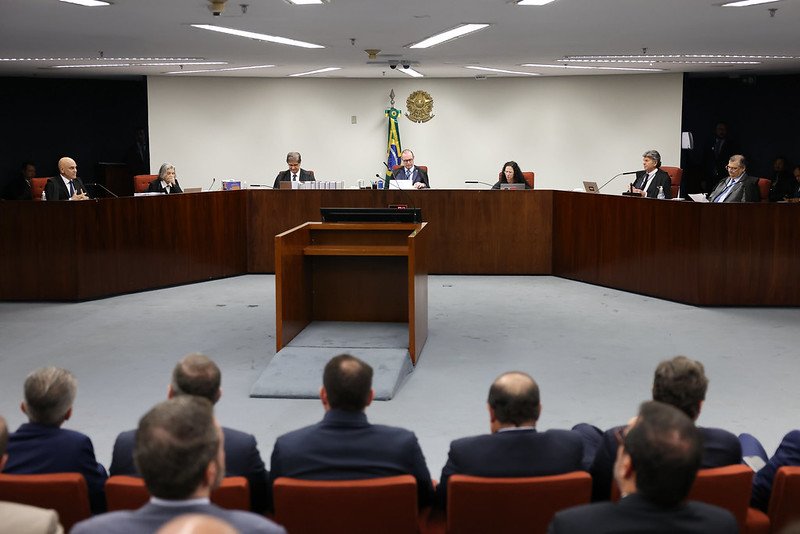
What happened: On September 11, 2025, Brazil’s Supreme Federal Court (STF) completed its merits judgment and sentencing in a case concerning an alleged attempt to overturn the country’s democratic order after the October 2022 presidential election. The court’s First Chamber convicted former president Jair Bolsonaro and seven associates.
Bolsonaro was convicted by a 4-1 vote of armed criminal organization, attempted violent abolition of democratic rule, coup d’état, aggravated damage to public property and deterioration of protected heritage. The court imposed a prison sentence of 27 years and three months, initially under a closed regime, as well as a fine.
The verdict followed the First Chamber’s March 26, 2025 decision to accept charges brought by the Prosecutor General’s Office, a step that formally made Bolsonaro and the other seven accused defendants. The prosecution was brought by the Prosecutor General’s Office; the STF accepted the charges, tried the case and delivered the convictions.
Justice Luiz Fux voted to acquit Bolsonaro. The remaining four justices voted to convict him. All eight defendants in the case were convicted, although their sentences differed.
Why it matters
The case concerns events following the 2022 election and the January 8, 2023 attacks on Brazil’s federal institutions. The STF’s ruling represented a judicial finding, at the trial stage, that the offences charged against Bolsonaro had been established. It did not rest on an arrest or accusation alone: the court held a trial, issued a written judgment and set sentences.
The judgment also marked a significant institutional moment because the country’s highest court adjudicated allegations relating to an effort to disrupt democratic rule. For international readers, the sequence illustrates the distinct roles of Brazil’s prosecutorial and judicial institutions: prosecutors filed the case, while the Supreme Court panel assessed it and issued the judgment.
The bigger picture
Bolsonaro rejected the outcome through his legal team. His defense said it received the conviction with “profound disagreement and indignation,” maintained that he had not participated in a coup plan, and pursued challenges to the ruling.
The court published the written judgment on October 22, 2025. After rejecting the available ordinary challenges, the STF declared Bolsonaro’s conviction final on November 25, 2025 and ordered execution of the sentence. This means the conviction’s current legal classification is a final judgment.
That status does not mean all litigation over the matter has ended. In May 2026, Bolsonaro’s lawyers filed a separate criminal-review action seeking to annul the final conviction. The available record does not establish the final outcome of that extraordinary challenge. Its filing does not alter the classification of the November 2025 judgment as final.
By the numbers
- 8: defendants convicted in the case.
- 4-1: the vote to convict Bolsonaro, with Justice Luiz Fux voting for acquittal.
- 27 years and 3 months: Bolsonaro’s prison sentence, initially in a closed regime, plus a fine.
- March 26, 2025: the date the STF First Chamber accepted the Prosecutor General’s Office charges.
- November 25, 2025: the date the STF declared Bolsonaro’s conviction final and ordered execution of the sentence.
What happens next
The relevant unresolved procedural development in the available information is the criminal-review action filed in May 2026. It seeks annulment of Bolsonaro’s final conviction, but no final disposition is established in the record provided. Unless and until that status changes through a recorded judicial decision, the STF’s November 2025 final judgment remains the operative classification of the case.