When Vale’s B-I tailings dam at the Córrego do Feijão mine collapsed in Brumadinho, Minas Gerais, on January 25, 2019, it caused deaths and widespread social, economic and environmental damage. Minas Gerais officially records 272 victims, a total that includes two unborn children.
More than six years later, the disaster’s reparation framework has entered a different phase. Vale reported that it completed the payment obligations under its judicial agreement in October 2026 and that approximately 84% of all commitments had been completed by the third quarter of that year. But the agreement also requires physical and environmental work whose timetable extends to 2031, while the criminal cases remain in the evidence-gathering stage.
The distinction matters for international readers assessing corporate accountability after industrial disasters: disbursement of funds is not the same as completion of remediation, and a civil reparation settlement does not resolve individual claims or determine criminal liability.
A record settlement at the time it was signed
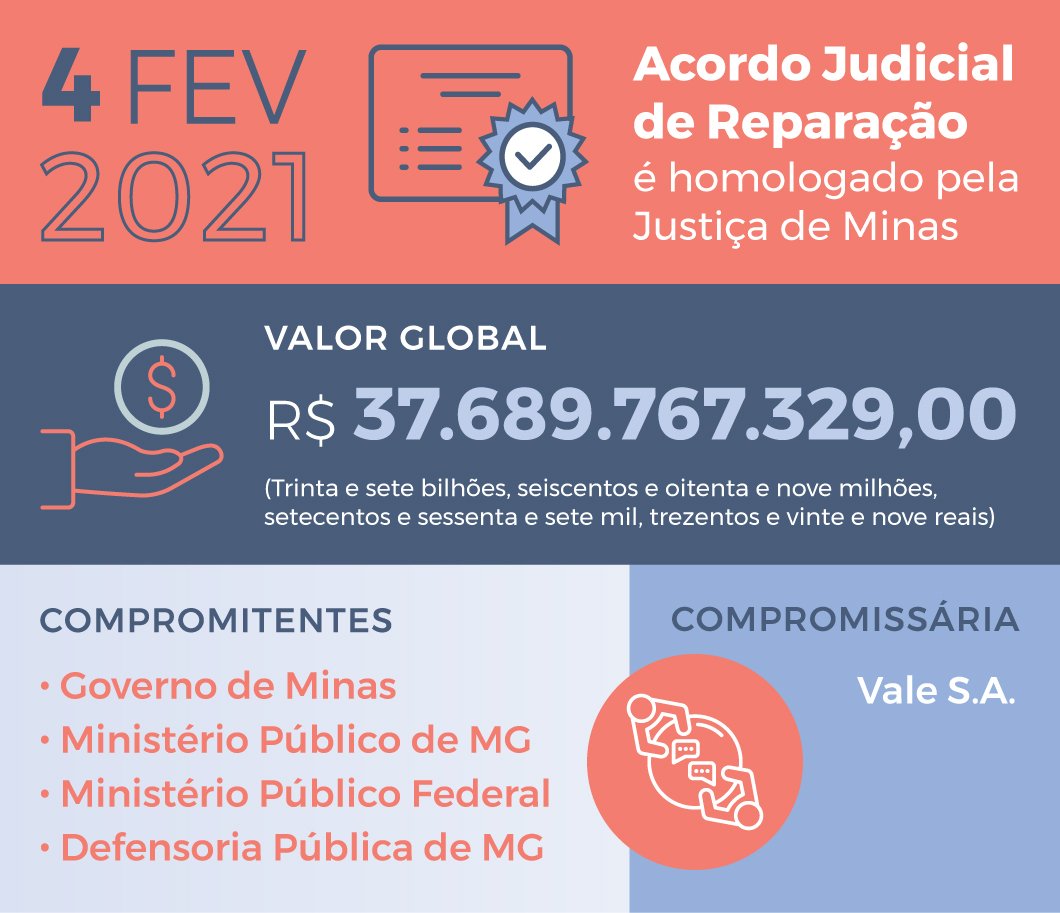
Vale, the Minas Gerais government, federal and state prosecutors, and the Minas Gerais public defender signed the judicial reparation agreement on February 4, 2021. The Minas Gerais Court of Justice mediated the agreement and approved it judicially.
Its estimated global value was R$37.69 billion. Minas Gerais described it as Brazil’s largest reparation settlement when it was concluded. That historical qualification is now important: an October 25, 2024 settlement over the Mariana/Rio Doce disaster was valued at R$132 billion, exceeding the Brumadinho agreement.
The Brumadinho accord is structured around more than a headline monetary figure. It separates obligations already undertaken, obligations to pay, and obligations that Vale must finance and execute. That design means progress is measured not only by money transferred, but also by the delivery of specific projects and remediation work.
The settlement addresses collective and diffuse damage arising from the collapse. It does not extinguish individual claims, which can proceed separately, and it does not end the criminal proceedings connected to the disaster.
How the agreement channels reparation funds
Under the agreement, resources financed through the settlement are legally earmarked for specified initiatives. Minas Gerais says they cannot be diverted into the state’s ordinary cash flow or payroll. This is a significant feature of the arrangement: the settlement is intended to fund defined reparative measures rather than operate as unrestricted budget revenue.
Oversight is split according to who carries out the work. Initiatives executed by Vale are subject to independent external audits. Projects executed by the state are also overseen by the state comptroller, the audit court and the legislature.
This division reflects the agreement’s mixed mechanism. Some obligations require Vale to pay or fund initiatives; others require the company itself to perform environmental and reparative work. The framework therefore places corporate execution alongside public-sector project delivery, with distinct channels of scrutiny for each.
Payments are complete, but physical restoration is not
Vale’s reported completion of payment obligations in October 2026 marks a concrete milestone. The company also reported approximately 84% overall completion through the third quarter of 2026. That company-reported figure refers to the agreement as a whole.
It should not be conflated with a separate Minas Gerais measure stating that 85% of initiatives directed toward affected municipalities had been completed. The two percentages cover different scopes: one is Vale’s overall assessment of agreement commitments, while the other concerns municipal-directed initiatives.
Several of the most consequential obligations remain on a longer timetable. Vale’s published schedule sets 2028 as the target for removing tailings from the Paraopeba River, 2030 for completing the degraded-area recovery plan, and 2031 for concluding all performance obligations.
These dates illustrate why the settlement cannot be treated as fully completed merely because payment obligations have ended. Environmental restoration involves work on the river system and degraded areas that extends beyond the financial phase of the agreement.
Criminal accountability remains before the courts
The civil settlement and the criminal cases follow separate institutional tracks. As of March 2026, criminal proceedings involved 15 individuals as well as Vale and TÜV SÜD. The individuals face charges that include 270 counts of qualified homicide and environmental offenses; the companies face environmental-crime charges.
The difference between 270 homicide counts and the state’s official total of 272 victims reflects the inclusion of two unborn children in the latter figure.
In June 2026, the criminal case was at the evidentiary-instruction stage, with testimony and other evidence still being collected before any final judicial decision. The cases therefore remain at trial stage. Charges and ongoing proceedings do not establish the guilt of the individuals or companies involved.
The continued criminal process underscores another limit of the reparation agreement: it creates a pathway for repairing collective damage and financing specified measures, but it does not decide criminal responsibility.
Why the long timetable matters
Brumadinho shows how disaster reparation can unfold on several clocks at once. Financial obligations may reach completion before river cleanup and land recovery. Publicly managed initiatives can be subject to one form of oversight while company-executed obligations are independently audited. And civil repair can continue in parallel with unresolved criminal litigation.
For affected communities, the remaining milestones are practical rather than merely administrative: tailings removal from the Paraopeba River is scheduled for 2028, degraded-area recovery for 2030, and final completion of performance obligations for 2031. Those dates provide measurable benchmarks against which the later phase of the agreement can be assessed.
For Brazil’s mining sector and public institutions, the case remains a test of whether a court-mediated settlement can sustain oversight over a multiyear recovery process after the immediate financial commitments have been met.