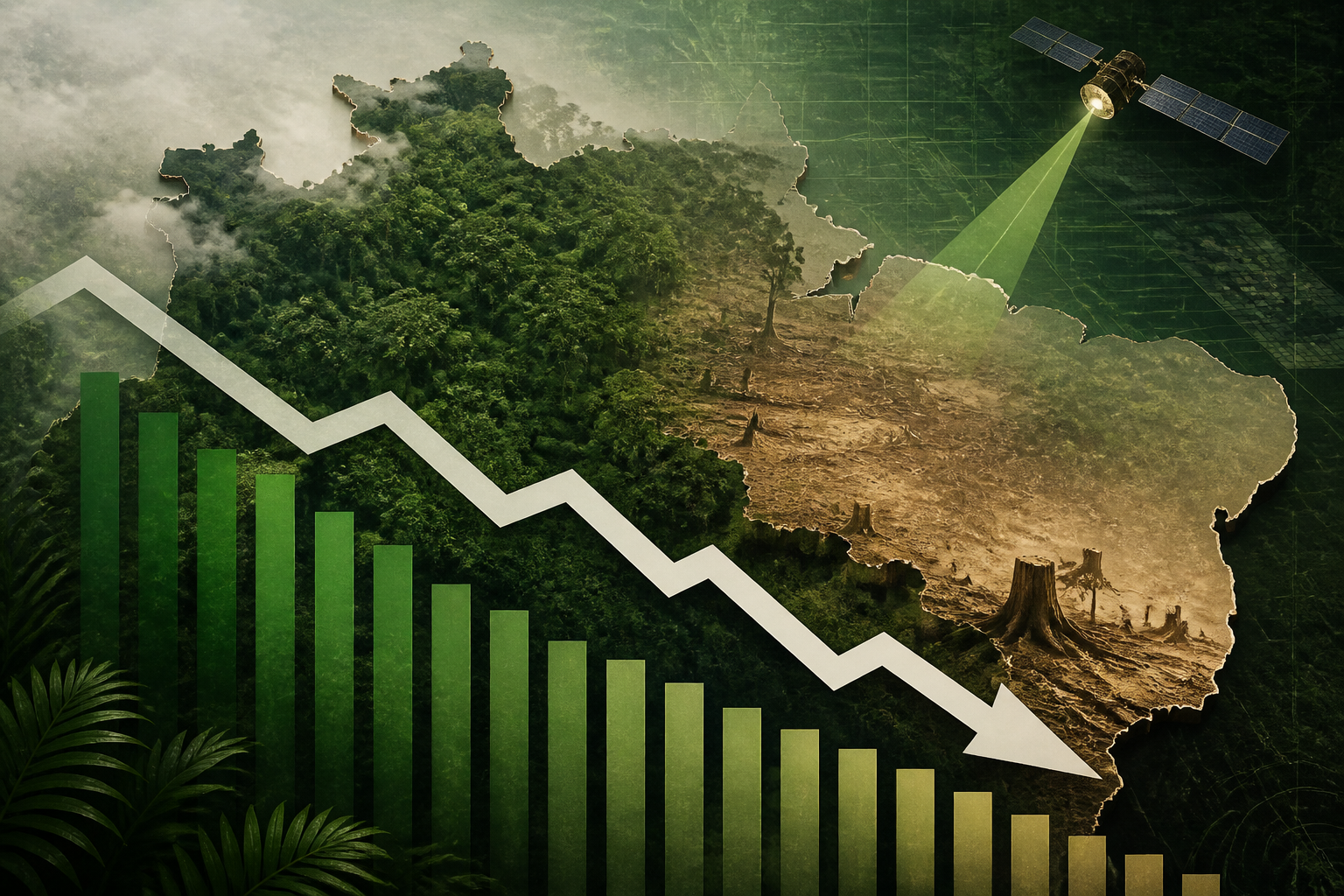
Annual deforestation in Brazil’s Legal Amazon fell to 5,731 square kilometres in 2025, according to consolidated figures from the National Institute for Space Research, known as INPE. The result extends a decline from a 2021 peak of 13,038 square kilometres in the agency’s PRODES monitoring series.
The 2025 figure refers to the monitoring year running from August 1, 2024, through July 31, 2025. It follows consolidated PRODES rates of 11,594 square kilometres in 2022, 9,064 square kilometres in 2023 and 6,518 square kilometres in 2024.
What happened
INPE’s figures show that measured annual deforestation in the Legal Amazon has declined in each year since 2021. The 2025 consolidated result was 5,731 square kilometres, less than half the area recorded at the 2021 high.
The 2024 and 2025 numbers were first released as estimates before being consolidated. The initial estimate for 2024 was 6,288 square kilometres; the consolidated figure was later set at 6,518 square kilometres. For 2025, the initial estimate was 5,796 square kilometres, later consolidated at 5,731 square kilometres.
Those revisions underline the importance of distinguishing preliminary estimates from final annual results when comparing Brazil’s deforestation data.
Why it matters
The Legal Amazon is the area covered by Brazil’s principal official Amazon deforestation-monitoring series. PRODES measures annual deforestation rates, providing the basis for tracking changes in forest loss over time.
The latest data establish a marked reduction relative to 2021, but they still record thousands of square kilometres of measured forest loss in the 2025 monitoring year. The figures document the direction and scale of change in deforestation measured by the system; by themselves, they do not establish that a particular policy, enforcement measure or administration caused the result.
The bigger picture
Brazil formally re-established its Action Plan for the Prevention and Control of Deforestation in the Legal Amazon, known by its Portuguese acronym PPCDAm, through Decree 11,367 on January 1, 2023. The decree also created a permanent interministerial commission for deforestation prevention and control.
The restoration of the plan is an institutional development relevant to Brazil’s deforestation policy framework. But INPE’s monitoring figures alone cannot determine how much any individual government action contributed to changes in the annual rate.
For international readers, another distinction is central: PRODES is not the same as DETER. PRODES produces the annual deforestation measure used for the figures above. DETER is a separate system that reports near-real-time alert areas and is designed to support monitoring and response.
By the numbers
- 2021 PRODES: 13,038 square kilometres of deforestation in the Legal Amazon.
- 2022 PRODES: 11,594 square kilometres.
- 2023 PRODES: 9,064 square kilometres.
- 2024 PRODES: 6,518 square kilometres in the consolidated rate, following an initial estimate of 6,288 square kilometres.
- 2025 PRODES: 5,731 square kilometres in the consolidated rate, following an initial estimate of 5,796 square kilometres.
- Latest DETER cycle: 2,874.38 square kilometres of alert area from August 2025 through July 2026, which INPE and the Environment Ministry described as a 36% reduction from the preceding cycle and the lowest result in that alert-series period.
What happens next
Future PRODES releases will show whether the downward movement in annual measured deforestation continues beyond 2025. DETER alerts will remain a separate, more immediate indicator of areas flagged by its monitoring system, rather than a final annual deforestation total.
Comparisons should therefore use like-for-like measures: consolidated PRODES rates for annual deforestation trends, and DETER data for changes in alert areas across its monitoring cycles.