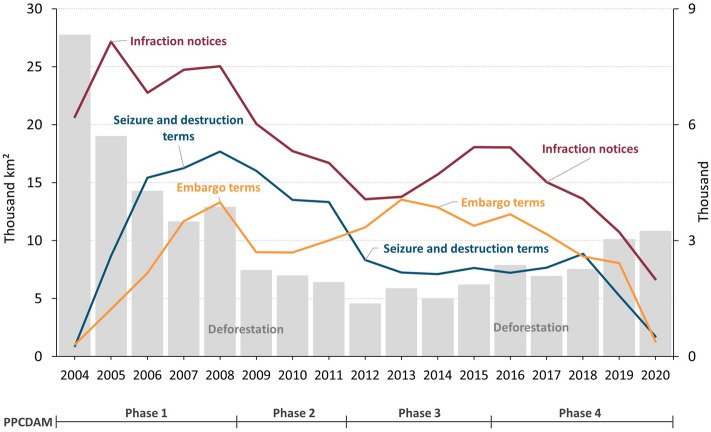
What happened: Brazil’s official satellite monitoring series offers a two-decade test of whether Amazon deforestation can be reduced—and whether those reductions last. Clear-cut deforestation in the Legal Amazon measured 27,772 square kilometres in 2004, before falling to 4,571 square kilometres in 2012, the lowest point in the historical series cited here.
The decline is widely associated with a broad set of measures under Brazil’s Action Plan for the Prevention and Control of Deforestation in the Legal Amazon, known by its Portuguese acronym PPCDAm. Research describes an interacting policy mix: satellite monitoring, command-and-control enforcement, protected areas, restrictions focused on priority municipalities and rural credit, and supply-chain interventions.
But the reduction did not become permanent. The official PRODES series later rose, reaching 13,038 square kilometres in 2021. It then declined again: PRODES registered 6,288 square kilometres of clear-cut deforestation for the monitoring year from August 1, 2023 to July 31, 2024, a 30.63% decrease from 9,064 square kilometres in the preceding annual result.
The 2024 result was the lowest since 2015, when the series recorded 6,207 square kilometres. It was not, however, a new historical low: the 2012 figure remained lower. The subsequent official 2025 series recorded 5,756 square kilometres, making it the newest annual observation in the data provided.
Why it matters
The record matters beyond Brazil because the Amazon is central to international climate and biodiversity concerns, while Brazil’s experience is often cited in debates over how governments can curb forest loss. The figures show that large reductions in monitored clear-cutting have occurred. They also show that such gains can be reversed.
It would be too simple to credit the 2004-2012 fall to a single policy. Academic research links much of the reduction to the combined policy approach, but commodity prices and other factors also affected outcomes. Equally, the later increase, including the 2021 peak, does not establish one sole explanation for the reversal.
What the sequence does support is a narrower conclusion: reductions in deforestation are not automatically durable. Sustaining them depends on continued implementation and effectiveness of policies rather than on a one-time fall in annual clearing.
By the numbers
- 2004: 27,772 km² of clear-cut deforestation in the Legal Amazon.
- 2012: 4,571 km², the lowest figure in this historical series.
- 2021: 13,038 km², following a renewed increase after 2012.
- 2024: 6,288 km², covering August 1, 2023 to July 31, 2024, down 30.63% from 2023.
- 2025: 5,756 km², the latest annual figure reported in the official series.
The bigger picture
Brazil’s fifth phase of PPCDAm sets an objective of zero deforestation by 2030. Related federal climate-policy materials also document a more specific objective of zero illegal deforestation by that year.
The distinction is important when interpreting the data. PRODES measures clear-cut deforestation. It does not measure all forest degradation, fire damage or illegal extraction, and its annual totals do not establish the legality of every area cleared. A PRODES total alone therefore cannot determine whether Brazil has met—or has failed to meet—its separate legality-based goal.
Nor does the lower 2025 total settle whether the 2030 objective will be achieved. It establishes a further annual decline in the monitored indicator, while the longer series shows why a single year is not enough to judge whether progress will hold.
What happens next
The relevant test will be whether the renewed downward trend continues through the rest of the decade and whether the policies identified with the earlier decline remain effective over time. Official PRODES monitoring will continue to provide a consistent measure of clear-cut deforestation in the Legal Amazon, but it should be read alongside the limits of what that measure can show about illegality and other forms of forest damage.