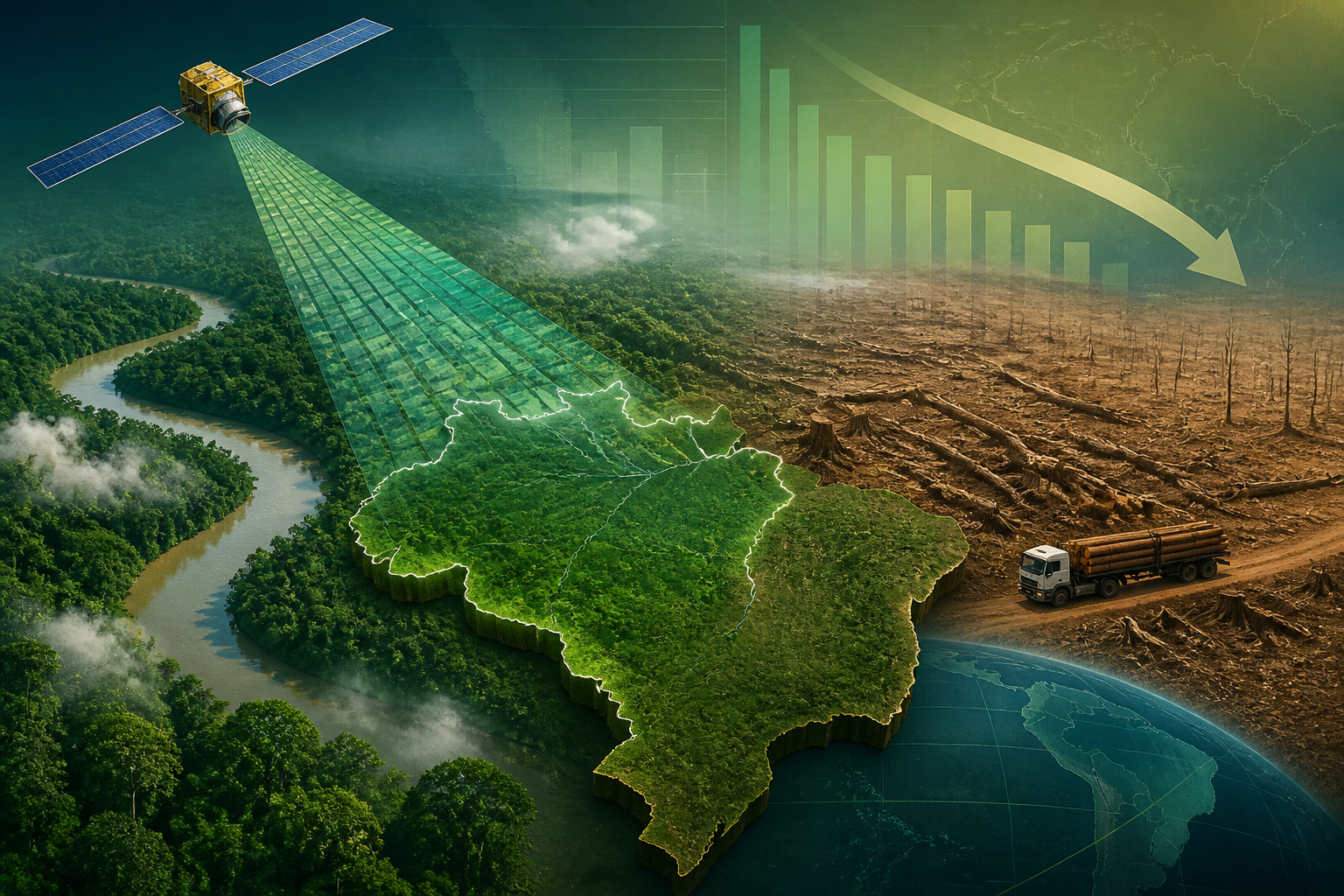
Brazil’s National Institute for Space Research, known as INPE, has reported that 3,335 square kilometers of forest were cleared in the country’s Legal Amazon between August 2025 and July 2026.
The result is 41.8% below the consolidated annual rate of 5,731 square kilometers recorded from August 2024 through July 2025. INPE said it was the lowest annual result in its Prodes monitoring series for the Legal Amazon, which began in 1988.
The previous low in that series was 4,571 square kilometers, recorded in 2012.
What happened
The figure comes from Prodes/BiomasBR, INPE’s monitoring system. It measures forest clearing in Brazil’s Legal Amazon over the specified August-to-July period.
For international readers, the geographic and methodological boundaries matter. The 3,335-square-kilometer result applies to forest clearing in Brazil’s Legal Amazon. It should not be treated as a measure of all forest degradation, fire damage or the whole Amazon basin, which extends beyond Brazil.
Associated Press also reported the official result. It said the Brazilian government linked the decline to the resumption of sanctions triggered by satellite detection, field enforcement and action against environmental crime.
That is the government’s stated explanation for the result. The available material does not independently quantify the contribution of each enforcement or policy measure to the decline.
Why it matters
The new Prodes result provides an annual, measurable indicator for scrutiny of Brazil’s environmental policy. It places the latest reported clearing rate below every previous annual result in INPE’s Legal Amazon series since 1988.
It also offers a benchmark against which Brazil’s stated federal objective can be assessed over time. President Luiz Inácio Lula da Silva has publicly committed Brazil to achieving zero deforestation by 2030.
The 2026 monitoring result is progress toward that deadline, rather than evidence that the 2030 commitment has already been fulfilled. The commitment has a defined endpoint, leaving future annual monitoring results to show whether the country reaches it.
By the numbers
- 3,335 km²: forest clearing recorded in the Legal Amazon from August 2025 to July 2026.
- 41.8%: the decline from the preceding 12-month period.
- 5,731 km²: the consolidated Prodes rate from August 2024 to July 2025.
- 4,571 km²: the prior low in INPE’s Legal Amazon series, recorded in 2012.
- 1988: the first year of the Prodes Legal Amazon series cited by INPE.
- 2030: the deadline for Brazil’s documented zero-deforestation objective.
The bigger picture
The announcement concerns a single annual indicator, but it is a significant one because it is part of a long-running official series. Comparisons in the announcement are therefore made against the same Legal Amazon Prodes record rather than against a broader estimate for all environmental damage affecting the Amazon.
The distinction is important when interpreting both the scale of the decline and the policy objective. A lower Prodes annual rate shows less measured forest clearing within the monitored area and period; it does not, on its own, establish a result for other forms of damage or for areas outside Brazil’s Legal Amazon.
What happens next
Brazil’s 2030 objective remains subject to future measurement. Further Prodes results will provide comparable annual data on whether forest clearing continues to fall as the deadline approaches.
For now, INPE’s latest reading establishes a record low for the Legal Amazon series while leaving the longer-term zero-deforestation commitment still to be assessed against its 2030 deadline.