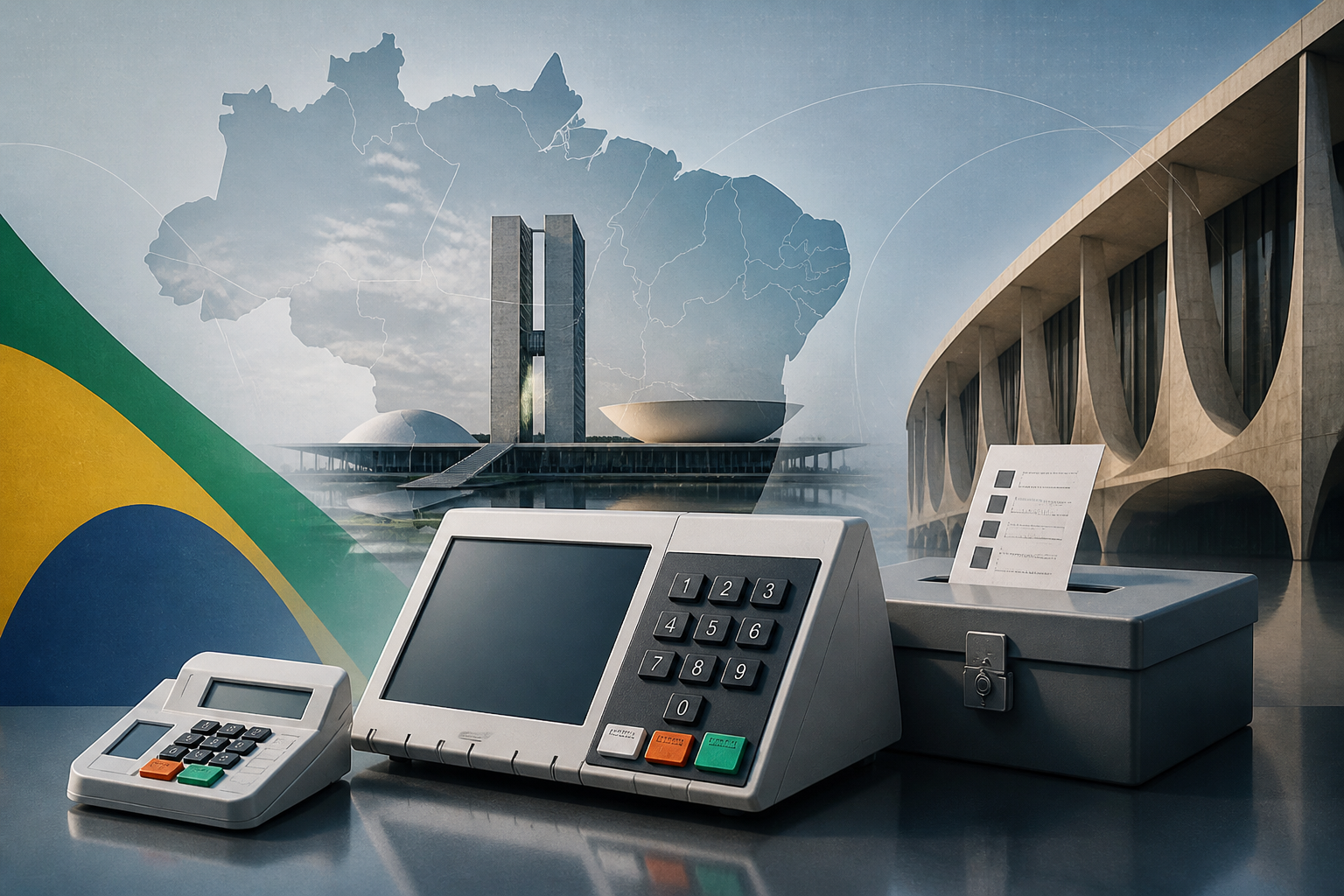
Brazil’s Superior Electoral Court, known as the TSE, said it completed an electronic-voting-machine integrity test involving two machines from the Federal District at its Brasília headquarters during the first-round election on October 4, 2026.
According to the court, the test found correspondence between votes marked on paper ballots and the totals recorded by the two electronic machines. The TSE said the procedure concluded without reported incidents.
The audit did not represent the launch of a new nationwide testing system. Brazil’s Electoral Justice has conducted the integrity test since 2002. The new element in this election was the location: it was the first time that two machines from the Federal District were tested at TSE headquarters.
What happened
The two machines were among 20 selected in the Federal District for the integrity test. The Federal District Regional Electoral Court, or TRE-DF, selected them in a public drawing on October 3.
Under the procedure, ballots are completed on paper in advance and then entered into the selected electronic machines in a simulated voting process. Auditors then compare the expected results, based on the paper ballots, with the totals registered by the machines.
The TSE reported that the two machines tested at its headquarters produced results corresponding to the paper ballots used in the simulation.
Why it matters
The integrity test is designed to audit whether electronic voting machines operate normally under election conditions. It is an institutional safeguard that provides a direct comparison between a controlled paper record and the electronic totals produced by the equipment.
The completed test is evidence of the result for the two machines examined at TSE headquarters. It should not be read as evidence that an irregularity had been identified beforehand, nor as a finding covering every voting machine used in the election.
For international readers, the procedure illustrates one of the checks used within Brazil’s electronic voting system. The test combines a public selection process with a simulated vote and a comparison of independently recorded paper ballots and machine totals.
The bigger picture
Brazil’s Electoral Justice has conducted integrity testing of voting machines since 2002. The TSE’s rules describe it as an audit of the machines’ operation under normal conditions.
In the Federal District, the October 4 exercise involved 20 machines in total. Beyond the two tested at TSE headquarters, 16 were designated for testing at the Legislative Chamber and two at a school.
The headquarters test therefore added a new venue for machines selected in the Federal District, while using an audit method already established by Electoral Justice.
By the numbers
- 2: Federal District voting machines tested at TSE headquarters.
- 20: Machines selected for the integrity test in the Federal District.
- 16: Machines designated for testing at the Federal District Legislative Chamber.
- 2: Machines designated for testing at a school.
- 2002: The year from which Brazil’s Electoral Justice has conducted the integrity test.
What happens next
The TSE’s October 4 report records the completed result of the headquarters test: the paper ballots matched the votes registered by the two selected machines, with no incidents reported by the court. The verified information provided does not specify further steps related to those two machines.