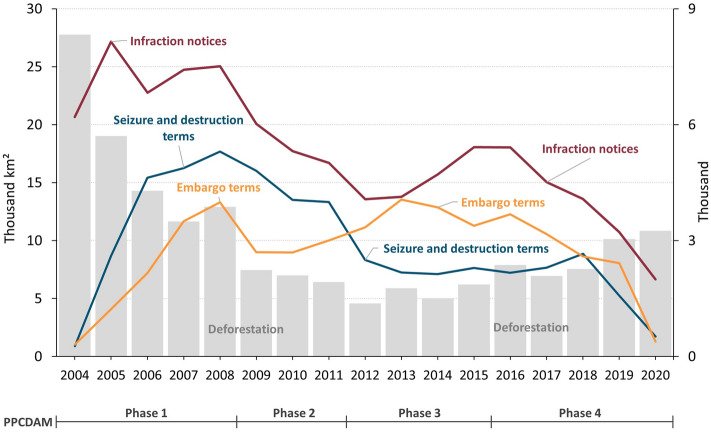
Brazil’s Legal Amazon recorded a steep fall in annual clear-cut deforestation between 2004 and 2012, an historical shift that remains central to debates over whether environmental policy can curb forest loss at scale.
INPE, Brazil’s space research agency, records 27,772 square kilometers of deforestation in the Legal Amazon in 2004 and 4,571 square kilometers in 2012 in its consolidated PRODES monitoring series. That is a reduction of 23,201 square kilometers, or 83.5%—commonly rounded to 84%.
The period coincided with the initial phases of the Action Plan for the Prevention and Control of Deforestation in the Legal Amazon, known by its Portuguese acronym PPCDAm. The plan began in 2004, with its first phase running through 2008. Its approach combined satellite monitoring, environmental enforcement, territorial management and measures intended to support sustainable production.
INPE identifies the 2012 result as the lowest annual PRODES deforestation rate since the agency’s monitoring began in 1988.
What happened
PPCDAm was launched as Brazil sought to coordinate federal action against deforestation in the Legal Amazon. Across its first three phases, the plan brought together measures involving observation of forest clearing, enforcement of environmental rules, land-governance policies and sustainable-production initiatives.
The timing matters: the major reduction in the PRODES series occurred during those early phases. Peer-reviewed research supports the conclusion that monitoring, enforcement and related public policies made a material contribution to the fall in deforestation.
But the available evidence does not show that PPCDAm alone caused the entire decline. Research also points to the relevance of commodity prices, exchange rates and private-sector measures. The historical record therefore supports a strong association between the policy era and the reduction, rather than a claim that one plan by itself explains every part of it.
Why it matters
The 2004-2012 experience is a significant test case for Brazil and for other countries trying to protect large forest areas while managing agricultural and land-use pressures. It shows that deforestation rates can shift sharply when monitoring, enforcement and land-governance measures are deployed together.
It also shows that a reduction is not automatically permanent. After reaching its 2012 low, annual PRODES deforestation in the Legal Amazon later rose again. It totaled 10,129 square kilometers in 2020, 10,851 square kilometers in 2021 and 13,038 square kilometers in 2022.
The later increase is a reminder that a historical low is a measurement of a particular year, not proof that the underlying drivers of forest loss have been resolved or that policy gains will endure without continued action.
By the numbers
- 27,772 km²: Legal Amazon deforestation recorded by PRODES in 2004.
- 4,571 km²: Consolidated PRODES deforestation figure for 2012, the lowest annual rate in the series since monitoring began in 1988.
- 23,201 km²: The absolute decline between 2004 and 2012.
- 83.5%: The decline from the 2004 level to the 2012 level.
- 13,038 km²: The annual rate recorded in 2022 after the series had risen from its 2012 low.
- 5,731 km²: The annual rate in 2025, following declines to 11,594 km² in 2023 and 9,064 km² in 2024.
The bigger picture
The PRODES figures are annual measurements of clear-cut deforestation in the Legal Amazon, a region that includes nine Brazilian states. They provide a consistent long-term benchmark for assessing changes in forest loss, but they should not be read as a complete account of all environmental pressures or all forms of vegetation clearing.
The renewed decline after 2022 places current policy discussions in the shadow of the earlier PPCDAm period. The central question is not simply whether Brazil can again lower the annual rate, but whether the conditions that support a sustained reduction can be maintained.
What happens next
The fifth phase of PPCDAm covers 2023 to 2027. Its documented objective is to establish conditions for zero deforestation by 2030.
The plan’s definition is more specific than an end to every form of legally permitted native-vegetation clearing. It calls for eliminating illegal deforestation and compensating legal clearing of native vegetation and its emissions.
That 2030 objective has a clear deadline, but it remains a future commitment. Its progress can be assessed against the annual PRODES series and against the plan’s stated definition of zero deforestation. The historical 2004-2012 decline provides evidence that coordinated policy can contribute materially to lower forest loss; the subsequent rise and later fall show why outcomes must be tracked over time rather than inferred from a single year.