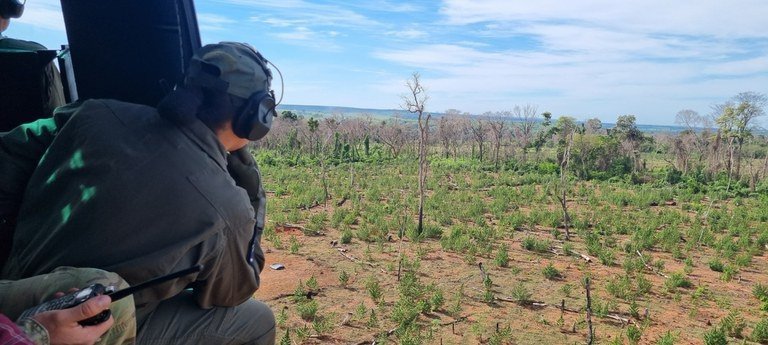
Brazil’s Federal Police and Paraguay’s National Anti-Drug Secretariat, known as SENAD, have begun the 59th phase of Operation Nova Aliança, a longstanding bilateral enforcement campaign targeting illicit cannabis cultivation and infrastructure linked to drug production and storage near the countries’ border.
The Brazilian Federal Police said the phase began on November 2, 2026, and is scheduled to run through November 13. Paraguay’s SENAD described the field deployment, or first operational day, as beginning on Tuesday in its November 4 report. The differing dates appear to distinguish the formal start of the phase from the start of operations on the ground.
The initiative is not a newly created cross-border program. It is the latest phase of cooperation that Brazilian authorities say has been conducted since 2012. Paraguay’s Joint Task Force and Public Ministry are supporting the operation, according to the Federal Police.
How the operation works
Nova Aliança uses aerial and ground actions to find, eradicate and destroy illegal cannabis plantations. The authorities also seek to identify and dismantle structures used for drug production and storage.
This approach addresses more than the crops themselves. Removing plantations targets the cultivation stage, while action against camps and storage sites is intended to disrupt the physical infrastructure needed to process, hold and move marijuana from production areas. The current deployment therefore focuses on both illicit planting and facilities that authorities associate with the supply chain.
The operation remains at the investigation and enforcement stage. The announcements name no suspects and report no arrests, charges or judicial findings. They therefore do not establish criminal liability for any individual or group.
Early results reported in Canindeyú
SENAD said early actions in Yby Pytã, in Paraguay’s Canindeyú department, destroyed two camps that it described as being used for drug production and storage. The agency also reported the removal of more than 48 tonnes of marijuana.
According to SENAD’s estimate, the initial actions represented an impact of more than US$7.2 million on trafficking. That figure is an agency-reported operational estimate and has not been presented in the available announcements as an independently audited measure.
The reported removal illustrates the scale at which the authorities are operating: the deployment is directed at cultivation zones and associated sites rather than solely at seizures during transport. Still, the early tally is a preliminary operational result from Paraguayan authorities, not a final assessment of the phase, which is scheduled to continue until November 13.
A bilateral response to a border-area supply chain
The participation of Brazilian and Paraguayan agencies reflects the cross-border nature of the enforcement challenge described by the two governments. Brazil’s Federal Police is working with SENAD, while Paraguay’s Joint Task Force and Public Ministry are providing support during this phase.
For readers outside the region, the key institutional point is that the operation links police activity across two national jurisdictions. Aerial reconnaissance and ground teams are being used to locate crops and facilities in the affected areas, while Paraguayan prosecutorial authorities are among the institutions supporting the deployment.
The 59th phase also shows the continuity of this cooperation. With bilateral operations dating to 2012, Nova Aliança has developed as a recurring enforcement framework rather than a one-off response to the latest reported destruction of crops and camps.
Environmental recovery is part of the announced plan
Beyond eradication and the destruction of infrastructure, the operation includes plans for the environmental recovery of land degraded by illicit planting. Relevant Paraguayan authorities are expected to carry out that work.
This element recognizes that the consequences identified by authorities extend beyond the immediate enforcement objective. Destroying crops and camps addresses illicit production, while recovery efforts are intended to address degradation associated with the planting areas. The announcements did not provide a timetable, acreage figure or specific restoration targets.
What happens next
The current phase is scheduled to continue through November 13. Authorities have announced continued aerial and ground activity aimed at locating and destroying illicit plantations and at identifying and dismantling production and storage structures.
Further operational results may be reported as the deployment proceeds. However, the verified announcements do not identify individual defendants or report criminal charges, and no conclusion about responsibility by any person or organization can be drawn from the operation’s launch or its initial reported results.